

American Block Manufacturing vs. Chinese Machinery: A 5-Point Buyer’s Guide for 2026
décembre 31, 2025
Résumé
The global market for concrete block machinery in 2026 presents a complex decision for buyers, particularly those in rapidly developing regions like Southeast Asia and the Middle East. This analysis examines the comparative merits of machinery sourced from traditional American block manufacturing hubs versus the increasingly sophisticated and cost-competitive options from Chinese manufacturers. It undertakes a structured, five-point evaluation focusing on automation and control systems, material science and block quality compliance, total cost of ownership, supply chain logistics, and long-term scalability. The investigation reveals that while American machinery has a long-standing reputation for robustness, leading Chinese machines, such as the QT series, now integrate high-quality international components, offer comparable automation levels, and provide significant economic advantages in both capital outlay and operational costs. The findings suggest that for many enterprises, Chinese machinery represents a viable, high-performance alternative capable of meeting rigorous international standards like ASTM, challenging the long-held paradigm of American market dominance.
Principaux enseignements
- Evaluate Total Cost of Ownership, not just the initial machine price.
- Verify that machine specifications meet or exceed local building codes like ASTM C90.
- Prioritize suppliers offering robust after-sales support and spare parts availability.
- Analyze the cost-per-block to understand the true profitability of your investment.
- Choose automation levels that match your local labor costs and production goals.
- Consider the long-term scalability of the american block manufacturing equipment you select.
Table des matières
- Navigating the Complexities of Automation and Control Systems
- Deconstructing Material Science and Block Quality Standards
- The Economic Equation: Total Cost of Ownership Beyond the Sticker Price
- Supply Chain and Logistics: From Factory Floor to Your Project Site
- Scalability and Future-Proofing Your Investment
- Foire aux questions (FAQ)
- Conclusion
- Références
Navigating the Complexities of Automation and Control Systems
When you stand on the floor of a modern construction material facility, the rhythmic hum and synchronized movements of machinery can be mesmerizing. It’s a mechanical ballet where raw materials are transformed into the foundational elements of our cities. At the heart of this ballet is the control system, the choreographer of the entire production. The decision between a machine rooted in the traditions of American block manufacturing and one from a contemporary Chinese powerhouse often begins with this very system. How much control do you need, and what technology provides it most effectively for your specific context?
For decades, the standard in American block manufacturing has been synonymous with durability and often, a certain type of straightforward, rugged control logic. Think of it like a classic, well-built American muscle car—powerful, reliable, but perhaps not always equipped with the latest digital interface. In contrast, the evolution of Chinese machinery has been a story of rapid technological adoption.
The PLC Debate: Siemens, Omron, and Proprietary Systems
The Programmable Logic Controller, or PLC, is the brain of any modern block-making machine. It’s a specialized industrial computer that reads inputs from sensors—monitoring pressure, position, and temperature—and makes decisions to control outputs like motors, hydraulic valves, and feeders. The brand and sophistication of the PLC are not trivial details; they dictate the machine's reliability, ease of maintenance, and the precision of every block produced.
High-end machines, whether of American or Chinese origin, often boast PLCs from globally recognized brands like Siemens or Omron. A machine specified with a Siemens PLC, for example, offers a certain peace of mind . It signals that the manufacturer has not cut corners on the most critical component. For a business in Jeddah or Singapore, sourcing a replacement sensor or hiring a technician familiar with Siemens software is far simpler than dealing with an obscure or proprietary system.
Let's consider the practical implications. Imagine your machine stops mid-cycle. An error code flashes on the HMI (Human-Machine Interface) screen. If it’s a Siemens system, your local engineer can likely diagnose the problem within minutes. If it’s a proprietary system from a lesser-known manufacturer, you might face days of downtime, navigating language barriers and time zone differences while trying to get support from the factory overseas. The few thousand dollars saved on a machine with a proprietary PLC can be erased by a single prolonged production stoppage.
The search data indicates that many leading Chinese manufacturers of the QT series machines explicitly advertise their use of Siemens PLCs and Schneider electrical components . This is a strategic move to directly address historical concerns about quality and to compete on the same technological footing as their Western counterparts. They are not just building a machine; they are integrating a globally serviceable ecosystem into their product.
Fully Automatic vs. Semi-Automatic: A Cost-Benefit Analysis for Your Market
The level of automation is perhaps the most significant factor influencing both the initial cost of a machine and its long-term operational expense. Let's break down what these terms really mean in the context of block production.
A semi-automatic machine, like the QT4-26 model, typically requires more human intervention . An operator might control the feeding of material into the mold, manually activate the pressing cycle, and physically move the finished blocks on their pallets to the curing area. This requires a team of several workers per shift.
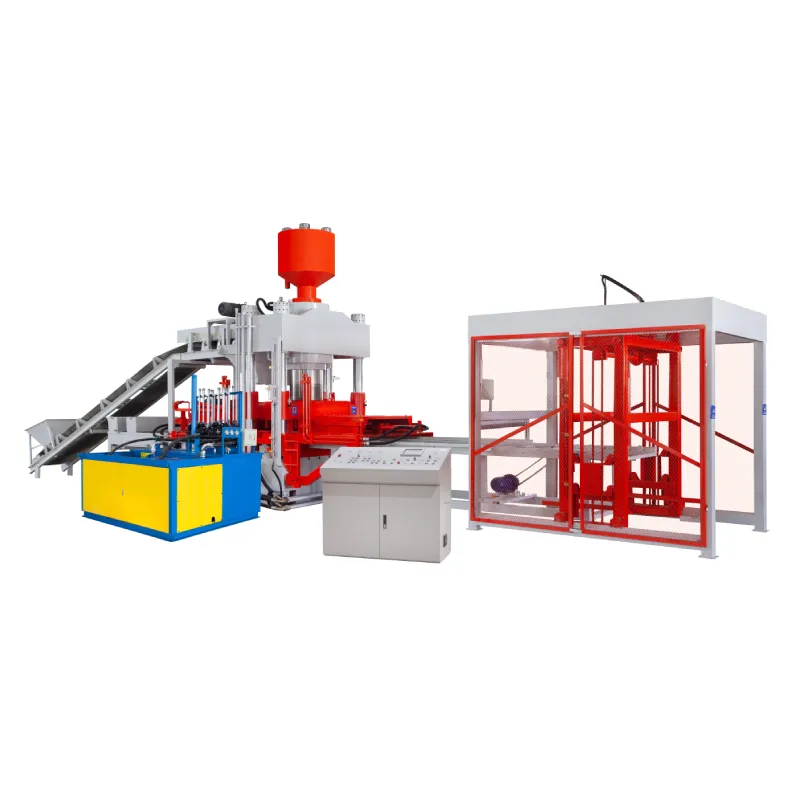
A fully automatic machine, such as a QT10-15 or QT12-15, automates these steps. It features automatic material feeding, PLC-controlled molding and pressing, and often includes a "stacker" that automatically receives the pallets of fresh blocks and arranges them in stacks for a forklift to transport. This drastically reduces the labor requirement, often needing only one or two supervisors to oversee the entire line.
The choice is not as simple as "more automation is better." It is an economic calculation specific to your market. In a region with high labor costs, like parts of the Middle East, the higher capital investment for a fully automatic machine can be recouped relatively quickly through wage savings. The consistency and higher output of an automatic line also mean a faster return on investment.
Conversely, in some Southeast Asian markets where skilled labor is more affordable, a semi-automatic line might be the more prudent entry point. It lowers the barrier to entry and can still achieve substantial production volumes. A business owner must weigh the upfront cost against the projected operational budget. How many workers will you need? What are the prevailing wages? How many blocks per day do you need to produce to meet demand and be profitable?
Remote Diagnostics and After-Sales Support in 2026
The world of industrial machinery has been transformed by connectivity. In 2026, a machine that cannot be diagnosed remotely is a liability. The gold standard for after-sales support involves an integrated system where, with your permission, a manufacturer's engineer can log into your machine's PLC from thousands of miles away. They can view error logs, monitor sensor readings in real-time, and guide your on-site staff through troubleshooting procedures.
This capability is a massive risk-reducer. It mitigates the "tyranny of distance" that can make importing machinery feel daunting. When evaluating a supplier, whether they are rooted in American block manufacturing traditions or are a leader in Chinese machinery, you must ask pointed questions about their support infrastructure.
- Do they offer 24/7 remote diagnostic support?
- What is the typical response time for a technical query?
- Can they demonstrate this remote access capability before you purchase?
- Is their support staff fluent in English or your local business language?
The reputation of American block manufacturing was built on service, with networks of local dealers and technicians. Chinese manufacturers are catching up fast, leveraging technology to bridge the geographical gap. They often provide comprehensive video tutorials, detailed manuals, and are increasingly establishing regional service centers or partnering with local technical firms to provide on-the-ground support.
Deconstructing Material Science and Block Quality Standards
A block making machine is, at its core, a device for applying precise amounts of force and vibration to a specific mix of materials. The quality of the machine is ultimately judged by the quality of the blocks it produces. Can it consistently create blocks that are strong, dimensionally accurate, and durable enough to meet the stringent requirements of modern construction? This is where an understanding of material science and international standards becomes paramount.
The perception has often been that the robust, heavy-duty construction of machinery from the American block manufacturing sector is necessary to produce blocks that meet high standards. While the build quality is indeed important, the science of block making is more nuanced. It’s a delicate interplay of mix design, vibration, and pressure.
Meeting ASTM C90 and Other International Standards
In the United States, the benchmark for load-bearing concrete masonry units is ASTM C90 (ASTM International, 2023). This standard specifies minimum compressive strength, maximum water absorption, and permissible dimensional tolerances. For example, a standard hollow block must typically achieve an average net area compressive strength of at least 2000 psi (approximately 13.8 MPa). While ASTM is an American standard, its rigor has made it a widely respected benchmark in many parts of the world, including the Middle East, where American engineering and construction practices have had a strong influence.
So, the critical question for a buyer in Dubai or Manila is: can a Chinese-made machine produce blocks that meet ASTM C90? The answer lies in the machine's technical capabilities. The ability to achieve high compressive strength is a direct function of the machine’s vibration system and hydraulic pressure. A well-designed machine uses high-frequency vibration to arrange the aggregate particles in the concrete mix into a dense, tightly packed configuration, minimizing voids. Then, a powerful hydraulic press compacts the mix, squeezing out excess water and ensuring a strong bond between the cement paste and the aggregates.
Modern Chinese machines, like the QT10-15, are specified with high vibration forces and rated pressures (often 21 MPa or more) that are explicitly designed to produce high-density, high-strength blocks . Manufacturers often provide test data and certifications showing their machines can produce blocks that meet not only Chinese GB/T standards but also international ones like ASTM. As a buyer, you should request this documentation. Even better, request that the manufacturer produce sample blocks using a mix design similar to what you plan to use, and then have those samples independently tested by a certified lab in your country.
The Role of Vibration Force and Hydraulic Pressure
Let's visualize what's happening inside the mold. When the concrete mix is first fed in, it's a loose jumble of sand, gravel, cement, and water. The first step is vibration. Imagine shaking a jar of mixed nuts; the smaller nuts will settle to the bottom and fill the gaps between the larger ones. Similarly, the vibration motors on the machine—often four or more Siemens motors on higher-end models—create a high-frequency shaking motion. This "fluidizes" the stiff concrete mix, allowing the particles to settle into their densest possible arrangement.
Once the material is compacted by vibration, the hydraulic system takes over. A massive hydraulic cylinder pushes the press head down onto the material in the mold, applying immense pressure. This final compaction is what gives the block its initial "green strength," allowing it to be demolded and hold its shape while it cures.
The synergy between vibration and pressure is key. Too much pressure without proper vibration can lead to a block that is dense on top but has a weak, honeycombed bottom. Too much vibration without sufficient pressure might not achieve the required density. The best machines, whether from the US or China, have advanced control systems that allow the operator to fine-tune the vibration frequency, amplitude, and duration, as well as the hydraulic pressure profile, to optimize the process for different mix designs and block types.
| Fonctionnalité | Traditional American Model (General Profile) | Modern Chinese QT Series (e.g., QT10-15) | Implications for Buyers in SEA/ME |
|---|---|---|---|
| Système de contrôle | Often rugged, reliable proprietary or older PLC systems. | Siemens PLC, Schneider electronics, Omron components common. | Chinese models offer globally recognized, easily serviceable parts. |
| Système de vibration | Powerful, often mechanically synchronized vibration. | 4+ directional, frequency-controlled Siemens vibration motors. | Advanced vibration control allows for optimization for local aggregates. |
| Système hydraulique | Robust, high-pressure systems. | Japan Yuken proportional hydraulic valves for precise control. | Proportional valves offer smoother operation and better block consistency. |
| Build/Frame | Very heavy-duty, thick steel frames, built for longevity. | Heavy-duty frames using high-strength steel (e.g., Q235). | Build quality is now comparable, with a focus on functional robustness. |
| Mold Technology | High-quality, long-lasting molds, often at a premium price. | Manganese steel molds with heat treatment for wear resistance. | Offers good mold life at a more accessible cost point. |
| Initial Cost | High capital investment. | Significantly lower capital investment. | Lower entry barrier and faster path to profitability. |
Mold Versatility: From Hollow Blocks to Interlocking Pavers
A block machine is only as versatile as the molds it can use. A modern construction market demands a wide range of products: standard hollow blocks for walls, solid blocks for foundations, interlocking pavers for roads and patios, curbstones for infrastructure, and even specialized insulation blocks.
One of the major strengths of the QT series and similar Chinese machines is their incredible versatility. These machines are designed for rapid mold changes . A crew can often switch from producing hollow blocks to producing paving stones in under an hour. This flexibility is a huge asset for a business. It allows you to pivot your production to meet market demand. If a large government contract for road paving comes up, you can quickly switch to paver production. If the housing market is booming, you can focus on hollow blocks.
The molds themselves are a feat of engineering. They are typically made from high-strength manganese steel and undergo a carburizing heat treatment process. This creates an extremely hard, wear-resistant surface, ensuring that the mold can withstand the abrasive action of the concrete and the high-frequency vibration for hundreds of thousands of cycles before needing replacement. The precision of the mold determines the final dimensions of the block. A high-quality mold will produce blocks that are consistent to within a millimeter, which is crucial for masons to build straight, true walls without needing excessive mortar to correct for imperfections. When investigating a supplier, ask to see their mold catalog and inquire about their capabilities for creating custom molds for unique product designs.
The Economic Equation: Total Cost of Ownership Beyond the Sticker Price
A wise business owner knows that the cheapest machine is rarely the most profitable one. The sticker price is just the down payment on a much larger financial commitment. The true measure of a machine's economic value is its Total Cost of Ownership (TCO), a concept that encompasses every expense associated with the machine over its entire lifespan. This is where a thoughtful, data-driven comparison between the American block manufacturing model and the Chinese machinery alternative becomes so revealing.
It’s tempting to look at the price tag of a Chinese machine, which might be 40-60% lower than a comparable American-made machine, and declare it the obvious winner. But we must dig deeper. Let’s construct a framework for evaluating TCO, considering the unique economic landscapes of Southeast Asia and the Middle East.
Calculating Cost-Per-Block: A Comparative Model
The ultimate metric for profitability is the cost to produce a single block. This figure is the culmination of all your inputs: capital, energy, labor, and materials.
Let's build a simplified model.
- Capital Cost Amortization: Take the total landed cost of the machine (purchase price + shipping + installation + import duties) and divide it by its expected useful life in production cycles. For example, a $150,000 machine expected to produce 15 million blocks over its life has a capital cost of 1 cent per block.
- Energy Cost: The search results provide power ratings. A QT10-15 machine might have a total power rating of around 63.5 kW . Calculate the energy consumption per hour, multiply by your local electricity rate (which can vary dramatically between, say, hydro-powered Malaysia and oil-producing Saudi Arabia), and divide by the number of blocks produced per hour.
- Labor Cost: For a fully automatic line, you might have a supervisor, a forklift operator, and a helper. For a semi-automatic line, you might need five or six people. Calculate the total hourly wage for the crew and divide it by the hourly block production.
- Maintenance & Spares: Allocate a budget for routine maintenance (hydraulic oil, filters) and expected spare parts (mold wear parts, sensors, belts). This is often estimated as a percentage of the machine's capital cost per year.
- Material Cost: This is the cost of cement, sand, aggregate, and water for one block. While not related to the machine itself, it's a huge part of the final cost-per-block.
When you plug in the numbers, the picture becomes clearer. The American machine's higher capital cost results in a higher capital cost per block. The Chinese machine's lower capital cost gives it an immediate head start. The crucial variables then become energy efficiency and maintenance. While older Chinese machines had a reputation for being less efficient, modern designs with high-quality motors and proportional hydraulic systems have closed this gap considerably.
| Élément de coût | High-End American Machine (Illustrative) | Modern Chinese QT10-15 (Illustrative) | Key Considerations for SEA/ME Buyers |
|---|---|---|---|
| Prix d'achat initial | $400,000 USD | $150,000 USD | Lower upfront cost of Chinese models frees up capital. |
| Shipping & Installation | $50,000 USD | $40,000 USD | Shipping costs are a major factor; proximity can be an advantage. |
| Energy Cost (per 8-hr shift) | $150 USD (assuming 75kW @ $0.25/kWh) | $127 USD (assuming 63.5kW @ $0.25/kWh) | Energy efficiency is now competitive; local electricity rates are key. |
| Labor Cost (per 8-hr shift) | $320 USD (2 operators @ $20/hr) | $120 USD (3 operators @ $5/hr, SEA avg.) | Labor arbitrage is a huge factor favoring automation in high-wage areas. |
| Entretien annuel | $12,000 USD (3% of CAPEX) | $7,500 USD (5% of CAPEX) | Higher percentage for Chinese model reflects proactive parts replacement. |
| Est. Cost per Block | $0.065 | $0.042 | The cost-per-block advantage for Chinese machines is often substantial. |
Note: This table is illustrative. Actual costs vary based on model, location, and operational factors. The labor cost difference is a major driver in the final calculation.
Energy Consumption and Operational Efficiency
The efficiency of a block machine is a direct result of its design. Think of the hydraulic system. An older, simpler system might keep the hydraulic pump running at full power continuously, dumping excess pressure through a relief valve. This is like keeping your foot floored on a car's accelerator and controlling the speed with the brake—it's simple, but it wastes a tremendous amount of energy, which is dissipated as heat.
A modern system, like those advertised with Japan Yuken proportional valves, is much smarter. It's like a sophisticated cruise control system. The PLC tells the valve to provide only the pressure and flow needed for a specific action—moving the feeder box, pressing the mold, or ejecting the block. The pump works only as hard as it needs to. This not only saves significant amounts of electricity over a year of operation but also reduces wear and tear on the hydraulic components and keeps the oil cooler, extending its life. The use of high-efficiency Siemens motors also contributes to lower overall energy consumption. When you are producing millions of blocks a year, a 10-15% reduction in your electricity bill is a substantial saving that drops directly to your bottom line.
Spare Parts, Maintenance, and Long-Term Viability
A machine is only as reliable as its weakest component. The fear of being stranded with a broken machine and no access to spare parts is a legitimate concern for any importer. This has historically been the Achilles' heel of sourcing from distant manufacturers.
The strategy of modern Chinese manufacturers to incorporate globally recognized brands is a direct answer to this fear. When a hydraulic valve from Yuken, an electrical contactor from Schneider, or a sensor from Omron fails, you are not dependent on the original machine manufacturer for a replacement. You can likely source that exact part from a local industrial supplier in your own city. This de-risks the purchase significantly.
For the custom-fabricated parts of the machine—the frame, the mold box, the tamper head—you are still dependent on the original manufacturer. This is where evaluating the supplier's commitment to after-sales service is so important. A reputable supplier will provide a comprehensive list of recommended spare parts to purchase with the machine. This "first aid kit" for your machine should include high-wear items like mold liners, proximity sensors, and hydraulic seals. Having these parts on hand can turn a potential week of downtime into a few hours of maintenance.
The long-term viability of an advanced machine de fabrication de blocs de béton also depends on the quality of its construction. Look for details in the specifications. What grade of steel is used for the frame? How thick is it? Is the frame heat-treated to relieve stress after welding? These details, often found in the fine print of a technical specification sheet, speak volumes about the manufacturer's commitment to building a machine that will last for a decade or more, not just one that looks good on the showroom floor.
Supply Chain and Logistics: From Factory Floor to Your Project Site
Purchasing a multi-ton piece of industrial equipment is not like ordering a book online. The journey from the manufacturer's factory in Shandong, China, or a workshop in the American Midwest, to your facility in the Klang Valley of Malaysia or a free zone in Oman is a complex logistical operation. Mastering this process is essential for a successful project launch. The timelines, costs, and procedures can vary dramatically and have a real impact on your business plan.
The traditional American block manufacturing supply chain often relied on a network of regional dealers who handled importation, delivery, and installation. While this offered a convenient, turnkey solution, it came at a price, with markups at each step. Buying directly from a Chinese manufacturer offers the potential for huge cost savings, but it places more responsibility on you, the buyer, to manage the logistics. Fortunately, in 2026, this process is more streamlined than ever before.
Lead Times and Shipping Considerations for SEA and ME
Let's trace the journey. Once you place an order, the manufacturer begins fabrication. A standard machine might have a lead time of 30-45 days. A more complex, fully automatic line could take 60-90 days. You must factor this into your project timeline.
Next comes shipping. Geographically, China has a distinct advantage for buyers in Southeast Asia and the Middle East. A container ship from Qingdao to Singapore might take 2-3 weeks. A shipment to Jebel Ali in Dubai might take 3-4 weeks. Compare this to shipping from an inland American city, which would first require trucking the machine to a port like Long Beach or Houston, adding time and cost before the multi-week ocean voyage even begins. These differences in shipping time and cost are not trivial. A month saved in transit is a month you can be producing blocks and generating revenue.
The machine itself is typically disassembled for shipping and carefully packed into one or more 20-foot or 40-foot containers. Reputable manufacturers have extensive experience in this. They will provide a detailed packing list and photos to ensure everything is accounted for. The machine parts are braced and secured to prevent shifting and damage during the rough ocean journey.
Installation, Commissioning, and Operator Training
The machine's arrival at your port is a major milestone, but the work is far from over. You will need to manage customs clearance, inland transportation to your site, and the physical installation.
This is another area where you must scrutinize a supplier's offerings. The best suppliers do not simply ship you a box of parts. They offer comprehensive support. Many Chinese manufacturers will, for an additional fee, send one or two of their own engineers to your site. This is an investment you should strongly consider. These engineers are not just mechanics; they are the experts who built and tested your machine.
- They will supervise the assembly, ensuring everything is put together correctly and safely.
- They will commission the machine, which involves connecting the power and water, loading the PLC software, and running the first test cycles.
- They will train your local operators, teaching them not just how to press the "start" button, but how to perform daily maintenance, troubleshoot common errors, and adjust machine parameters for optimal block quality.
This transfer of knowledge is invaluable. It empowers your team to take ownership of the machine and operate it efficiently and safely for years to come. The few thousand dollars spent on bringing in a factory engineer can save you tens of thousands in lost production and maintenance headaches down the line.
Navigating Import Duties and Regional Trade Agreements
The final landed cost of your machine will include import duties and taxes levied by your government. These can vary significantly from country to country. It is your responsibility as the importer to understand these costs.
Many countries in Southeast Asia are part of the ASEAN Free Trade Area (AFTA), which aims to reduce tariffs on goods traded within the region. Furthermore, China and ASEAN have a comprehensive free trade agreement. These agreements can potentially reduce the import duties on machinery sourced from China, providing yet another economic advantage.
Similarly, countries in the Gulf Cooperation Council (GCC) have a customs union, which standardizes tariffs. You should work with a local customs broker or freight forwarder early in the process. They are experts in navigating the complex web of trade regulations and can provide an accurate estimate of all the duties and taxes you will be required to pay. Having a clear picture of these costs is essential for creating an accurate project budget and avoiding unpleasant surprises when your machine arrives at the port.
Scalability and Future-Proofing Your Investment
Buying a block making machine is a long-term commitment. You are not just buying a piece of equipment; you are investing in a production capability that should serve your business for a decade or more. Therefore, it is essential to think beyond your immediate needs. Will the machine you buy today be able to grow with your business tomorrow? Can it adapt to new market demands, new materials, and new environmental regulations?
The concept of future-proofing your investment is about making strategic choices that maximize your options down the road. It’s about ensuring that your production line doesn't become a technological dead end. Both the American block manufacturing philosophy and the modern Chinese approach offer different paths to scalability.
Modular Design and Production Line Expansion
One of the most powerful trends in industrial equipment design is modularity. Instead of a single, monolithic machine, a production line is conceived as a series of interconnected modules. This is an area where leading Chinese manufacturers have excelled.
Think of it like building with LEGO bricks. You might start your business with a core block-making machine and a simple mixer. This is your initial, functional production line. As your business grows and you need to increase output, you can add more modules.
- Batching Plant: Instead of manually loading the mixer, you can add an automated batching plant with silos for cement and hoppers for different aggregates. A computer controls the weighing and mixing of materials, ensuring a perfectly consistent concrete mix for every batch.
- Cuber: After the blocks have cured, a robotic cuber can automatically stack them into perfect cubes, ready for shipping. This reduces labor and breakage.
- Face-Mix Unit: To produce high-value architectural blocks or two-tone pavers, you can add a secondary "face-mix" unit. This module adds a thin layer of colored, fine-textured concrete to the top of the block, creating a premium finish.
The advantage of this modular approach is that you can scale your investment in line with your revenue growth. You don't need to buy a massive, all-encompassing production line on day one. You can start with a core set of versatile block production solutions and expand your capabilities as the market rewards your efforts. When evaluating a supplier, ask them to show you a roadmap for expansion. How does their entry-level machine integrate with their more advanced automation modules?
Adapting to New Raw Materials and Sustainable Practices
The construction industry of 2026 is under increasing pressure to become more sustainable. This has profound implications for block manufacturing. There is a growing demand for "green" building materials and a push to incorporate recycled and waste materials into concrete production.
A future-proof machine must be able to handle this evolution. The raw materials for block production are no longer just sand, gravel, and cement. Manufacturers are experimenting with:
- Crushed stone and other industrial wastes (fly ash, slag, etc.)
- Recycled concrete aggregate (RCA) from demolition waste.
- Lightweight aggregates like perlite or expanded clay for producing insulation blocks.
Each of these materials has different physical properties—particle shape, density, and water absorption. A machine with a flexible and highly adjustable control system is better equipped to handle this variety. The ability to precisely control vibration frequency and hydraulic pressure allows an operator to develop new "recipes" for producing high-quality blocks from non-traditional materials. The robust construction and powerful vibration systems found in many modern QT-series machines make them well-suited for processing these often-abrasive and difficult-to-compact materials .
The Resale Value and Lifecycle of Block Making Machinery
While you may intend to run your machine for many years, it's wise to consider its eventual resale value. What happens in ten or fifteen years when you are ready to upgrade?
Historically, heavy-duty machines from the American block manufacturing sector have held their value well, thanks to their legendary durability. A 20-year-old American machine can often still be found operating productively.
The lifecycle of Chinese machinery is still being written. However, the modern trend of using high-quality, internationally recognized components significantly enhances their long-term prospects. A machine with a Siemens PLC and Yuken hydraulics will have a much better resale value than one with obscure, proprietary parts. Potential buyers in the second-hand market will recognize the value and serviceability of these components.
Furthermore, the modular design contributes to a longer useful life. An older machine can be updated and given a new lease on life by adding a new automation module. The core press, if well-maintained, can continue to be the heart of the production line for a very long time. As the global population of high-quality Chinese machines grows, a robust secondary market is developing, making them an increasingly liquid and viable long-term asset.
Foire aux questions (FAQ)
What is the real difference between a semi-automatic and a fully automatic block machine? A semi-automatic machine requires more manual labor, typically for tasks like feeding material and moving finished blocks. A fully automatic machine automates these processes, using sensors and a PLC to manage the entire production cycle from mixing to stacking, which significantly reduces labor costs and increases output consistency.
Can a Chinese-made machine produce blocks that meet American (ASTM) standards? Yes. Many modern Chinese machines, particularly higher-end QT series models, are engineered to meet international standards. They use powerful vibration and hydraulic systems and high-quality components to produce high-density blocks capable of passing rigorous compressive strength tests like ASTM C90. Always request certification or independent lab test results from the manufacturer.
How difficult is it to get spare parts for a machine imported from China? This has become much easier. Reputable manufacturers now use globally recognized brands for critical components like PLCs (Siemens), electronics (Schneider), and hydraulics (Yuken). These parts can often be sourced from local industrial suppliers. For custom machine parts, it's best to purchase a recommended spare parts package with your machine.
What is the typical lead time and shipping time to the Middle East or Southeast Asia? Manufacturing lead time is typically 30-90 days, depending on the complexity of the machine. Ocean shipping from a major Chinese port to Southeast Asia takes about 2-3 weeks, and to the Middle East, it takes about 3-4 weeks. This is often faster and more cost-effective than shipping from North America.
Is it necessary to have the manufacturer's engineer come for installation? While not mandatory, it is highly recommended. A factory engineer ensures the machine is assembled and commissioned correctly, preventing costly errors. Most importantly, they provide invaluable hands-on training for your local operators, which is crucial for long-term operational success and proper maintenance.
Conclusion
The landscape of industrial machinery is in constant flux, shaped by technological innovation and global economics. The decision-making process for a significant capital investment like a block making machine requires a perspective that looks beyond historical reputations and sticker prices. As we have examined through the lenses of automation, quality standards, economics, logistics, and scalability, the narrative is no longer a simple one of American durability versus Chinese affordability.
The evidence from 2026 clearly shows that leading Chinese manufacturers have systematically addressed the historical concerns of the global market. By integrating world-class components, adopting sophisticated control technologies, and engineering their machines for versatility and high performance, they now present a compelling value proposition. For a business owner in Southeast Asia or the Middle East, the advantages in terms of lower Total Cost of Ownership, logistical proximity, and scalable, modular designs are substantial and cannot be overlooked.
The path of American block manufacturing, with its legacy of incredible robustness, still holds merit, yet the modern Chinese machinery offers a pathway to profitability and quality that is more accessible and, in many cases, better aligned with the dynamic needs of today's developing markets. The final choice rests on a careful, individualized analysis of your specific market conditions, production goals, and financial strategy. The prudent investor will weigh all five points, gather data, and make a decision based not on outdated perceptions, but on the tangible realities of the 2026 global marketplace.
Références
ASTM International. (2023). Standard specification for loadbearing concrete masonry units (ASTM C90-23). ASTM International. https://www.astm.org/c0090-23.html
cyunmachinery.en.made-in-china.com. (n.d.). Full automatic hot selling qt 4-25 concrete block making machines. Made-in-China.com. Retrieved October 26, 2026, from
hfblockmachine.com. (n.d.-a). QT series block making machine. Retrieved October 26, 2026, from
hfblockmachine.com. (n.d.-b). QT4-25. Retrieved October 26, 2026, from
hfblockmachine.com. (n.d.-c). QT10-15. Retrieved October 26, 2026, from
hfblockmachine.com. (n.d.-d). QT4-26 block machine. Retrieved October 26, 2026, from
hongfamach.com. (n.d.). Block machine | AAC block production line | Concrete mixing plant – Hongfa Machinery. Retrieved October 26, 2026, from